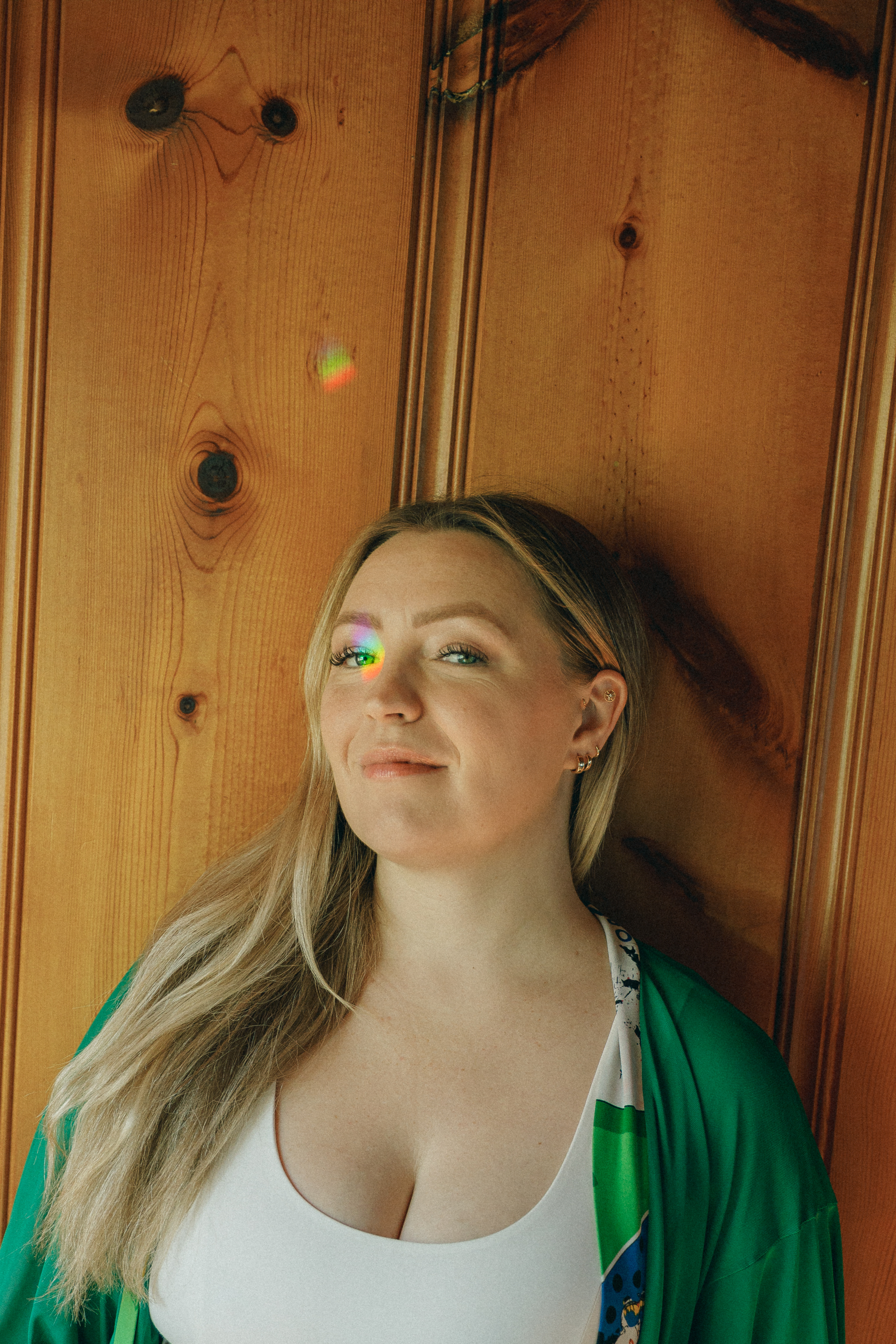
a 6-week small group for people who want a real answer to this question. not a rushed one. not a borrowed one. their own.
led by a death doula & therapist. this question lives close to the core of what shapes a life.
@howcarolinecarolines on Instagram · @death.ed on TikTok
i've been a death doula for about 8 years and a therapist for 4. over time, my work took on a specialty: helping people navigate the giant, murky seas of do i want to have a child, or remain childfree?
i've worked with individuals, couples, and throuples on this. queer couples, solo mothers by choice, people whose partners want different things. what i've learned, sitting with all of them, and from sitting with people at the end of their lives, is that this choice lives very close to the core of what shapes a life.
there is no universally right answer. only the one that is most true for you.
i started running small groups because i saw how much more possible this work becomes when you're doing it alongside other people who are sitting in the same exact place.
thoughtful, self-aware, and used to carrying a lot. you have built a life. you may have a partner or be doing this alone. you may lean yes, lean no, or be exhausted by the question itself.
what you want now is not more noise. it is a truer signal.
(i had my kids at 37 and 39. for those with a uterus, the body may add its own urgency to this question — and that pressure is real and deserves real attention. but this question belongs to anyone carrying it, regardless of gender.)
here's what i've learned after 8 years as a death doula and 4 as a therapist — sitting with people in the most tender moments of their lives:
deciding whether to have a child or be childfree is not a logical decision. if you're asking "is this a good call for my finances?" you'll never get a satisfying answer. this decision lives somewhere else entirely.
once upon a time, marriage was forever. career paths were lifelong. now? even tattoos are removable. this is one of the few decisions that actually can't be undone. that weight is real. you're not being dramatic for feeling it.
most of the people i work with are in this range. for those with a uterus, there's a kind of internal PSA from the body: "make a conscious call, or i will make it for you." the "going out of business sale," as one comedian put it. but the weight of this window is felt by anyone in it, regardless of biology. the urgency is real, and it deserves real attention.
no matter what you decide, there is a life you will never know. there are things you will miss out on. this is one of those choices where you cannot "have it all." it can ache. bring anxiety. regret. anger. sadness. it may surprise you: these things are so normal.
we can try to avoid this pain by staying in ambiguity. but that doesn't make it go away — it just keeps you in limbo.
just like you can't pause death, you can't stop life from life'ing. the body is gonna body. life is gonna life. whether there is war, financial strain, or the end of a relationship. if time is up, time is up.
"as a death doula, i've sat with people at the end of their lives. the choice to have a child or be childfree lives very close to the core of what shaped a life. there is no universally right answer. only the one that is most true for you."
To Babe or Not to Babe is a 6-week small group program (part group therapy, part facilitated exploration) for people navigating whether to have a child or remain childfree.
for the past few years, i've been working with individuals, couples, and throuples on this question. queer couples, solo mothers by choice, partnered and single. there are so many paths. what they all share is the weight of not knowing, and the wish that there was a real space to work through it.
this is that space. small (8 people). live. real conversation, six weeks in a row, with people who get it.
i'm not here to nudge you toward an answer. i'm here to help you find your own.
part of that process is hearing from real people who've actually lived both sides. as part of the program, you get access to a library of recorded AMAs (ask me anythings) with people who chose to be childfree, people who became parents, queer families, solo parents by choice, and people who landed in places that don't fit neatly into either category. this isn't a black-and-white decision. there is so much grey. so much individual preference. so many ways to build a life. the AMAs exist so you can hear directly from people who designed theirs on purpose.
Weekly group calls. Real conversation, real people, real breakthroughs.
Guided prompts to keep the work going between sessions.
Intentionally small. You will be known. not just another face on a screen.
Recorded conversations with people who've actually made this choice — and are honest about what it's like.
this is a guided, emotionally intelligent space for people who are tired of spinning in indecision. who want more than advice. more than a checklist. more than someone else's answer.
this work is structured, intimate, and grounded in the real texture of a life. relationships. fertility. time. grief. freedom. family systems. desire. fear. identity. body. you get to bring all of it.
most people who join have already read the books, listened to the podcasts, and talked to their therapist. the difference here is live, structured conversation — with other people sitting in the same exact place.
this is not about rushing into certainty. it is about creating enough structure, reflection, and honesty that your answer becomes harder to ignore.
explore your inherited scripts, your current life, your body, your fears, and the versions of yourself that have been answering on autopilot.
separate your actual desire from family pressure, partner dynamics, cultural expectations, and the fear of regret.
move from abstract spiraling into concrete next steps. whether your answer is yes, no, or not yet — you leave with a clearer relationship to time, desire, and choice.
each week builds on the last. we go places that books and podcasts can't take you.
we look at what's actually influencing you: your relationship to time, your body, the messages you've absorbed. we explore why staying in ambiguity can feel protective. and we do the coin toss exercise. (it tells you more than you expect.)
we go back. what was modeled for you? what did your parents give up (or seem to give up)? what does that have to do with what you want now? we watch Ruth Chang's TED talk on how to make hard choices, and talk about why this particular decision can't be reasoned through the usual way.
this week you live as if your answer is: you will not become a parent. not hypothetically. actually. you move through your days with that as true. what comes up? what opens? what closes? we debrief together at the end of the week.
this week you live as if your answer is: you are becoming a parent. again, actually. not as a thought experiment. you write a letter to your future child. you feel the weight of that. we debrief what the week brought up.
you write a eulogy for the version of yourself that will not exist, whichever path you choose. you wear black all week. this sounds heavy. it is. it's also where something real often shifts. no matter what you decide, you are grieving something. we don't skip that part.
we work backwards from age 45. where do you want to be? what does that tell you about now? you leave this week not just with reflection. with a concrete next step, and a deadline for when you take it.
not "clarity someday." an actual answer, by week six. it will be one of these three:
you know you want to become a parent, and you have a clear next step toward that.
you know a childfree life is yours, and you're ready to stop waiting for someone to give you permission to claim it.
you still don't know — but you have a specific next step in your exploration, and a deadline for when you will take it. that's not the same as limbo. that's a plan.
staying in ambiguity doesn't make the pain of this go away. it just keeps you there longer.
included in the program: a library of recorded ask-me-anythings with real people who've made this choice and are honest about what it's actually like. not a highlight reel. a real conversation.
people who decided not to become parents, what that decision actually felt like, and what their lives look like now.
queer couples and individuals who built families in their own way, on their own timeline, and what that path really looked like.
people who chose to become parents without a partner. the decision, the fear, the logistics, and what they want you to know.
people who landed somewhere unexpected. who changed their minds. who found their own answer and it surprised them.
the question isn't "baby or no baby." it's "what kind of life do i want to live?" the AMAs exist to show you what it looks like when people actually design that on purpose.
i work with people of all genders: queer couples, solo people considering solo parenthood, people in relationships where partners disagree — anyone sitting in this particular uncertainty.
despite being a generally decisive person, i've spent the last few years wrestling with whether to become a parent. with most of my friends and peers already on that path, i often felt isolated in my indecision. this group provided a warm, supportive space and a clear framework to help me explore what this choice truly means, both in my mind and in my body. turns out it's normal to need to think really hard about one of the few irreversible decisions we will make in life.
a small intimate village to talk about a subject that's sometimes too deep and complicated to talk through with your friends and family. prompts and exercises that make you really pause and dig deeper into yourself. it's beautiful to find pieces of yourself in other's journeys. truly an investment in yourself and a future that feels aligned with what you really want.
it felt so sacred to share a space with others processing a subject as vulnerable, tender, and intentional as whether or not to become a parent. caroline facilitated a rich and potent space that helped us each show up with our truths. i will move forward holding each of their precious stories close to my heart as i make the next right, true decision for myself.
if a small group isn't the right fit right now, or you'd prefer to do this work one-on-one, reach out. i work with individuals and couples navigating this question in private sessions.
get in touch →six weeks. small group. the space to actually figure this out.
⚡ group size is intentionally small. application required.
the books and self-guided programs are valuable. but if you're here, you've probably already done all of that. and you're still going in circles.
what's different here: live conversation with other people sitting in the same exact place, facilitated by someone who has spent 8+ years doing this work through the lens of death and end-of-life reflection. nobody else is bringing this perspective.
there's also something that only happens in a group: you hear someone else describe exactly what you've been feeling, and suddenly you realize you're not broken, not weird, not behind. that alone changes something.
information and frameworks, but you're still doing it alone. no one to reflect back what they hear. no community of people in the same place.
deeply valuable, but expensive, and you're missing the group dynamic — the recognition of yourself in other people's stories.
live group, led by a death doula & therapist, small enough that you're actually seen, structured enough to move you forward.
yes. the decision has three valid forms. by the end of six weeks, you will have one of these: yes (you know you want to become a parent, and you have a next step), no (you know a childfree life is yours, and you're ready to claim it), or not yet, with a clear next step and a deadline (you still don't know, but you're no longer just waiting. you have a concrete action and a date). that last one is not the same as limbo. it's a plan. all three are real answers. none of them are "i'm still going in circles."
books and self-guided programs are valuable. but most people who join this group have already read them. the difference is live conversation with other people navigating the same parenthood ambivalence, guided by a death doula and therapist who has spent 8+ years doing exactly this work. the group dynamic creates something no book can replicate.
neither, exactly. i am a licensed therapist, and this work is deeply therapeutic. but the program is a facilitated group experience, not individual therapy. it may feel therapeutic. it is not a substitute for psychotherapy. if you're already in therapy, this often complements that work beautifully.
you're still welcome here. strong leanings often carry grief, fear, family conditioning, or unexamined assumptions underneath them. this work helps you know what is truly yours. and that's true whether you're ambivalent or not.
this comes up constantly. the program helps you separate what you actually want from what your relationship dynamic is telling you to want. that's often the most important thing you can do, both for yourself and your relationship.
this is exactly the age most of the people i work with are. something happens in the 30–45 window. the question becomes more urgent, more real. that's precisely when this work matters most. i had my own kids at 37 and 39. the narrative that this decision has to be made young is not supported by the people i work with.
no. i work with people of all genders: queer couples, non-binary people, trans people, men, throuples, solo people considering solo parenthood. the question of whether to become a parent belongs to anyone sitting in it. this cohort will reflect who applies.
most groups are 8 people. intentionally small. small enough that you will actually be known, not just another face on a screen. the group dynamic is a core part of what makes this work.
you can, and some couples have. but many participants from previous cohorts have said, unprompted, that they were glad they did it separately. when you're in the room with your partner, it can be hard to find your own answer versus the answer that feels safe in the relationship. doing it individually first often makes the eventual conversation with your partner clearer and more honest. that said, it's your call. you know your relationship best.
one live group call per week (90 min) plus optional reflections and journaling between sessions (about 30–60 min). most people find themselves thinking about the material throughout the week. no heavy homework load.
you fill out a short application form (5 minutes). i read every application personally and reach out within 24–48 hours. if it's a good fit, i'll send you a payment link. this isn't about being exclusive. it's about making sure the group dynamic works for everyone in it.
if you sign up and your availability changes before the course begins, you can switch to a different group at no extra charge. once the course begins, no refunds are given. the group dynamic depends on everyone being committed.
based on the cohorts so far: roughly 50% leave with yes (they know they want to become a parent and have a concrete next step), 40% leave with no (they know a childfree life is theirs and are ready to claim it), and 10% leave with "not yet" — but that last group doesn't leave in limbo. they leave with a specific next step in their exploration and a date by which they will take it. that is still an answer. all three are real outcomes. none of them are going in circles.
totally fair to wonder.
here's the honest answer: i don't think one path is braver or more self-honoring than the other. when i hear childfree women say "i chose myself," i actually push back on that framing. i think whoever follows what their desires are chose themselves. whatever they chose. the parent who really wanted to be a parent chose themselves too.
and as someone who is a parent, i know firsthand how hard this is. i would never want someone to walk into it reluctantly, without clarity, without really knowing. that would be bad for them and bad for the child.
my job isn't to nudge you toward what i chose. it's to help you hear yourself.
new cohorts run a few times a year. fill out the application and note that you're interested in a future round — i'll reach out personally when the next one opens.
Join the Waitlist →applications for future cohorts are always welcome.
the first step is not certainty. it is contact. start here.
application takes 5 minutes. i read every one personally. starts may 2026.
spots limited · application required